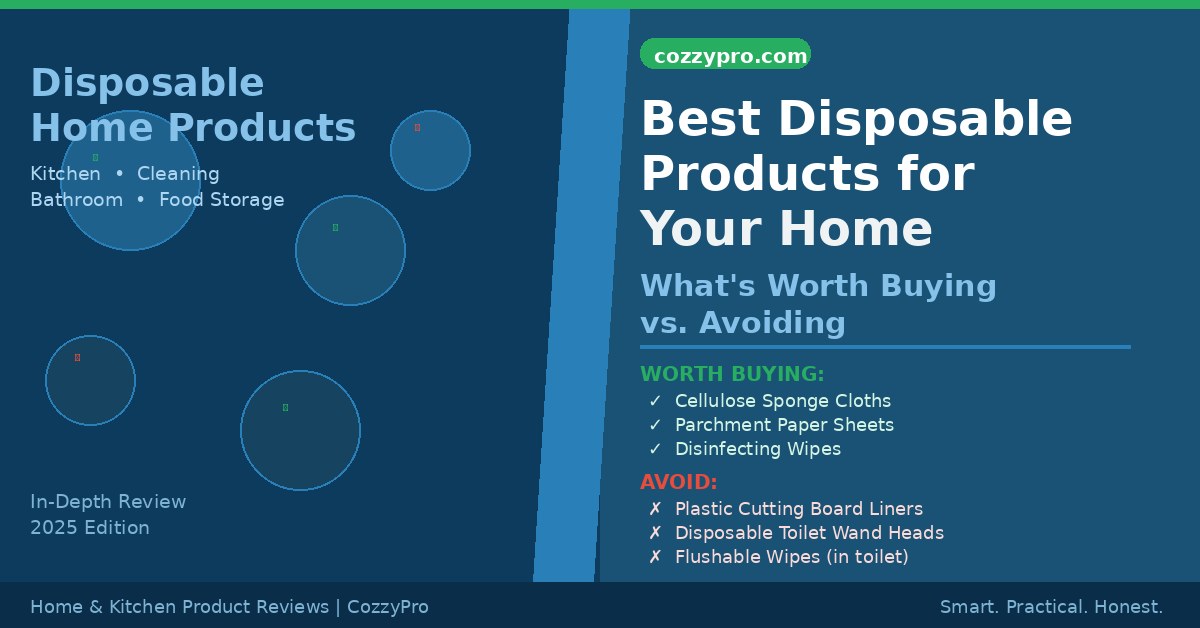
A no-nonsense guide to the disposable household items that actually save you time and money — and the ones that are quietly draining your wallet and cluttering your home.
Walk through any big-box store or scroll through Amazon, and you’ll find dozens of disposable home products promising to make your life easier. Some of them genuinely deliver — they’re hygienic, convenient, and shockingly good value. Others are elaborate solutions to problems that don’t really exist, and they wind up in the back of your cabinet after one use.
At CozzyPro, we put everyday home and kitchen products through their paces so you don’t have to waste money on trial and error. In this in-depth review, we’re cutting through the marketing noise and giving you an honest breakdown of the best disposable products for your home — covering the kitchen, bathroom, cleaning, and more — plus a clear verdict on what’s worth buying and what you should flat-out avoid.
Whether you’re stocking up for a busy household, managing a rental property, or just tired of re-washing the same musty kitchen sponge, this guide has you covered.
📋 Table of Contents
- Why Disposable Products Still Matter in a Modern Home
- Kitchen Disposables: Worth It vs. Skip It
- Cleaning Disposables: The Good, the Bad, and the Wasteful
- Bathroom Disposables That Are Actually Hygienic (and a Few That Aren’t)
- Food Storage & Prep Disposables
- A Note on Eco-Friendliness & Cost Per Use
- Smart Buying Tips for Disposable Home Products
- Quick-Reference Verdict Table
- Frequently Asked Questions
- Key Takeaway Summary
1. Why Disposable Products Still Matter in a Modern Home
There’s a growing cultural push toward reusables, and rightly so. But dismissing disposable products entirely ignores a practical reality: in many situations, a high-quality disposable is the more hygienic, more time-efficient, and even the more economical choice.
Think about a busy household cooking six nights a week. Reusable kitchen towels need washing — and if you’re using them on raw meat surfaces, they become a bacterial breeding ground between laundry cycles. Or consider a family managing a stomach virus: disposable cleaning wipes can contain pathogens in a way that a re-used cloth simply cannot.
The key is being strategic. Not all disposables are created equal. Some categories are excellent investments; others are pure gimmick. The goal of this guide is to help you tell the difference so every dollar you spend on disposable home products actually earns its keep.
2. Kitchen Disposables: Worth It vs. Skip It
✅ WORTH BUYING: Disposable Sponge Cloths / Swedish Dishcloths
✅ Worth Buying
Disposable Cellulose Sponge Cloths (e.g., Swedish Dishcloths)
The humble kitchen sponge is one of the most germ-laden objects in the average home — some studies have found more bacteria on a used kitchen sponge than on a toilet seat. Traditional foam sponges trap food particles, stay wet, and become malodorous within days.
Disposable cellulose sponge cloths — often marketed as “Swedish dishcloths” — are a middle ground between reusable and fully disposable. Each cloth is good for around 200+ uses, is machine washable for light refresh use, and can be composted at end of life. They absorb 15–20 times their weight in liquid, dry faster than foam sponges (reducing bacterial growth significantly), and replace up to 17 rolls of paper towels per cloth.
Brands like Superscandi, Full Circle, and Wettex are widely available and highly rated. A pack of 10 costs roughly $15–$20 and lasts a well-equipped kitchen 3–4 months.
👍 Pros
- Dramatically more hygienic than foam sponges
- Compostable / eco-friendlier option
- Excellent absorbency and scrubbing capacity
- Cost-effective over time
👎 Cons
- More expensive upfront than foam sponges
- Still need replacing every 4–6 weeks
- Not ideal for heavy-duty scrubbing
✅ WORTH BUYING: Parchment Paper / Baking Liners
✅ Worth Buying
Pre-cut Parchment Paper Sheets & Baking Liners
If you do any amount of baking or roasting, parchment paper is genuinely one of the best investments in the kitchen. Pre-cut sheets (rather than rolls) are a small upgrade that makes them even more practical — no tearing, no curling, and they fit standard sheet pans perfectly.
High-quality parchment can withstand oven temperatures up to 450°F, is naturally non-stick without added chemicals, and eliminates the need for greasing pans — which actually improves baking performance for cookies and pastries. It also dramatically reduces the baked-on residue you’d otherwise spend 15 minutes scrubbing off your sheet pans.
Brands like Reynolds Kitchens Cut Rite and If You Care (unbleached, FSC-certified) are excellent choices. A box of 100 pre-cut half-sheet liners costs around $10–$14 and will last most home bakers several months.
👍 Pros
- Genuine time-saver for cleanup
- Improves baking results
- Pre-cut sheets are perfectly sized
- Available in unbleached/eco versions
👎 Cons
- Single-use waste adds up over time
- Not reusable for heavily soiled applications
💡 Pro Tip: Silicone Baking Mats as a Complement
For everyday cookie sheets, a silicone baking mat (like Silpat) is a better long-term investment. Keep a stash of parchment for anything that needs lining at high heat or awkward shapes, and use your silicone mat for standard baking tasks. This hybrid approach is the most practical and eco-friendly strategy.
❌ AVOID: Disposable Plastic Cutting Board Sheets
❌ Avoid
Disposable Plastic Cutting Board Liners / Sheets
These are exactly what they sound like — thin, single-use plastic sheets you lay on top of your existing cutting board, supposedly for hygiene and easy cleanup. In theory, they sound like a reasonable idea. In practice, they’re one of the worst kitchen disposables on the market.
The sheets are too thin to use comfortably with a proper chef’s knife — the blade either slides or the sheet bunches up. They offer no meaningful improvement in hygiene over a properly cleaned cutting board. They’re almost entirely plastic waste. And the cost per use is absurdly high given that a dishwasher-safe polyethylene cutting board does the same job indefinitely.
Skip them entirely. Instead, use separate color-coded cutting boards for meat, vegetables, and bread — a simple, proven system that’s both more hygienic and more cost-effective.
👍 Supposed Pros
- Sounds convenient in theory
- Keeps main board clean
👎 Real Cons
- Slippery and dangerous to cut on
- Excessive plastic waste
- No real hygiene benefit over proper board cleaning
- Very high cost per use
3. Cleaning Disposables: The Good, the Bad, and the Wasteful
✅ WORTH BUYING: Disinfecting Wipes (Targeted Use)
✅ Worth Buying
Disinfecting Wipes (Lysol, Clorox, or Generic EPA-registered)
For high-touch surfaces — light switches, door handles, remote controls, bathroom faucets, and counters after handling raw meat — disinfecting wipes are genuinely useful. The key word is targeted. When used for their intended purpose (not as a general-purpose cloth for everything), they provide reliable surface disinfection that a spray-and-wipe setup with a reusable cloth doesn’t always match in convenience or effectiveness.
EPA-registered wipes are tested to kill 99.9% of common bacteria and viruses within the stated contact time (typically 2–4 minutes — most people don’t let sprays dwell long enough). During cold and flu season, or in households with compromised immune systems, this matters.
Buying in bulk (e.g., Costco 5-pack canisters) dramatically reduces cost per wipe. Store-brand versions are often just as effective as Clorox or Lysol at a fraction of the price.
👍 Pros
- Effective disinfection for high-touch surfaces
- No cross-contamination risk
- Fast and convenient for spot cleaning
- Bulk buying brings cost down significantly
👎 Cons
- Over-use creates unnecessary plastic waste
- Some contain harsh chemicals (check for bleach-free if needed)
- Not a substitute for deep cleaning
⚠️ USE WITH CAUTION: Disposable Mop Pads (Swiffer-style)
⚠️ Use With Caution
Swiffer WetJet Pads & Similar Disposable Floor Cleaning Pads
The Swiffer WetJet system is one of the most polarizing products in the cleaning world, and for good reason — it straddles the line between genuinely useful and unnecessarily wasteful. For quick surface-level mopping between deep cleans, it’s convenient and fast. The pads pick up dust and light debris well, and the locking-in design prevents you from spreading dirt around.
However, the ongoing cost is real. At roughly $0.50–$0.75 per pad plus the proprietary solution, the annual cost for a household doing weekly mopping can hit $60–$100 for pads alone. Third-party reusable microfiber pads designed to fit Swiffer-style handles are a worthwhile upgrade — they cost about $10–$15 for a multi-pack and can be machine washed over 100 times. This is one disposable system where a hybrid approach (reusable pad + occasional disposable for deep sticky messes) is the smart play.
👍 Pros
- Genuinely fast for light maintenance mopping
- Locks in dust and pet hair effectively
- No bucket or wringer needed
👎 Cons
- Significant ongoing cost vs. traditional mop
- Not effective for heavy-duty or sticky messes
- Reusable pad alternatives exist and are much cheaper
❌ AVOID: Single-Use Toilet Cleaning Wand Heads
❌ Avoid
Disposable Toilet Scrubber Wand Systems (e.g., Scrubbing Bubbles Fresh Brush)
These systems — a plastic wand with snap-in disposable scrubbing heads — are marketed as a hygienic alternative to a toilet brush. The appeal is obvious: you clean, pop off the head, and throw it away without touching anything gross. But the real-world performance doesn’t justify the expense or waste.
The disposable heads are typically pre-loaded with cleaning solution, which sounds efficient but actually limits your ability to use your preferred cleaner or adjust the amount. The plastic waste per head is significant. At roughly $0.80–$1.20 per head for name-brand versions, a household cleaning two toilets weekly spends $80–$125 per year just on scrubber heads.
A silicone toilet brush ($12–$18 for a quality one) is just as hygienic — silicone doesn’t harbor bacteria the way bristle brushes do, dries quickly, and doesn’t need to be replaced. This is one of the clearest cases where the disposable option is simply not worth it.
👍 Supposed Pros
- No rinsing of a brush head required
- Feels hygienic in the moment
👎 Real Cons
- Very high ongoing cost
- Significant plastic waste
- No performance advantage over a silicone brush
- Limited cleaning solution flexibility
4. Bathroom Disposables That Are Actually Hygienic (and a Few That Aren’t)
✅ WORTH BUYING: Disposable Toilet Seat Covers
For households with young children who use public bathrooms, or for anyone managing a rental property or vacation home, disposable toilet seat covers are a genuinely hygienic, low-cost addition to the bathroom. They fold flat, store easily under the counter, and provide real psychological comfort (and some physical barrier protection) in shared bathrooms.
A box of 250 covers costs around $7–$12 and fits a standard toilet. Scott, Hospeco, and various store brands offer reliable options that are septic-safe and biodegradable.
✅ WORTH BUYING: Disposable Hand Towels for Guest Bathrooms
✅ Worth Buying
Disposable Paper Hand Towels for Guest Bathrooms
This is one of the more overlooked but genuinely smart disposable upgrades for a home. Shared cloth hand towels — even freshly laundered ones — can harbor bacteria and viruses within 24–48 hours in a frequently used bathroom. Many households switch their guest bathroom to disposable paper towels permanently, keeping a decorative holder stocked with folded paper hand towels.
Brands like Kleenex Luxury Hand Towels and Scott Pro offer a soft, absorbent option that’s far nicer than standard bathroom tissue. The cost is roughly $5–$10 for 60–100 sheets. For households that entertain frequently or have multiple people sharing one bathroom, the hygiene benefit is real and the cost is reasonable.
👍 Pros
- Significantly more hygienic than shared cloth towels
- Guests appreciate the touch of hospitality
- Reduces laundry burden
👎 Cons
- Ongoing cost vs. washing cloth towels
- Paper waste
❌ AVOID: Flushable Wipes (Unless Septic-Certified)
⚠️ Important: “Flushable” Wipes Are Often Not Truly Flushable
Despite the labeling, most “flushable” wipes do not break down adequately in residential plumbing and septic systems. They are a leading cause of clogged pipes and sewage system blockages. If you use wet wipes in the bathroom, dispose of them in the trash — not the toilet — unless the product is certified by INDA’s flushability standards and approved for your local sewer system. For most homes, a bidet attachment ($25–$80) is a dramatically better long-term solution.
5. Food Storage & Prep Disposables
✅ WORTH BUYING: Quality Zip-Lock Freezer Bags
✅ Worth Buying
Ziploc / Glad Freezer-Grade Storage Bags
Freezer-grade zip bags are one of the most versatile and genuinely useful disposable products in any home kitchen. They’re good for marinating proteins, portioning bulk meat purchases for freezing, storing leftover soups, organizing small items in the pantry, and dozens of other kitchen tasks.
The key is buying freezer-grade (not sandwich-grade) for most tasks — they’re thicker, more puncture-resistant, and have a much better seal. Ziploc and Glad are the category leaders for a reason; their seals consistently outperform generic brands on the shelf. A gallon-size box of 30 costs around $5–$8.
Note: many people wash and reuse these bags 3–5 times before discarding, which is safe as long as they haven’t held raw meat. This dramatically improves their cost and environmental profile.
👍 Pros
- Incredibly versatile across kitchen tasks
- Excellent seal quality prevents freezer burn
- Can be safely washed and reused multiple times
👎 Cons
- Plastic waste if not reused
- Generic brands often have inferior seals
⚠️ USE WITH CAUTION: Aluminum Foil Pans
Disposable aluminum foil pans — the kind you’d use for a casserole or a roast — are genuinely useful for potlucks, events, and cooking in bulk for gifting. They’re not ideal as a primary cooking vessel because they conduct heat unevenly and can warp. But as an occasional convenience item, especially for transporting food or cooking large quantities of items where cleanup would be a chore, they earn a spot in the pantry. Buy heavy-duty versions (not the thin, ultra-cheap foil pans) for best results.
❌ AVOID: Disposable Plastic Cutlery for Regular Home Use
This one is straightforward. Disposable plastic cutlery has a legitimate place at outdoor events and large parties. For everyday home use, it’s a waste of money and contributes significantly to plastic pollution. A basic stainless steel flatware set costs $20–$35 and lasts years. There is no scenario where single-use plastic forks make sense at your own kitchen table.
6. A Note on Eco-Friendliness & Cost Per Use
One of the most useful frameworks for evaluating any disposable product is cost per use. A pack of 100 parchment sheets for $12 works out to $0.12 per bake — reasonable. A pack of 10 disposable scrubber heads for $8 works out to $0.80 per cleaning — not so reasonable when a $15 silicone brush lasts two years.
🌿 The Eco-Conscious Disposable Test
Before buying any disposable home product, ask three questions: (1) Is this genuinely more hygienic than a reusable alternative, or does it just feel that way? (2) Is the cost per use justified? (3) Does a reusable version exist that performs equally well? If the answer to #3 is “yes” and the cost and hygiene factors aren’t compelling, opt for reusable. If the disposable wins on at least two of the three questions, it’s likely worth including in your home.
It’s also worth noting that “eco-friendly” claims on packaging deserve scrutiny. Compostable means nothing if your area doesn’t have a composting program. Biodegradable has no legally defined timeline in most markets. When in doubt, look for third-party certifications like BPI (Biodegradable Products Institute) or FSC (Forest Stewardship Council) for paper products.
7. Smart Buying Tips for Disposable Home Products
1
Buy in bulk for products you genuinely use. Unit cost drops dramatically when you buy larger quantities of products you’re certain about. Warehouse stores (Costco, Sam’s Club) offer significant savings on disinfecting wipes, paper towels, parchment paper, and zip bags.
2
Don’t buy in bulk until you’ve tested a small quantity. Never order a 6-month supply of a product you’ve never used. Buy a single pack first, test it for a few weeks, then commit to bulk purchasing.
3
Check the store brand. For commodity disposables like zip bags, parchment paper, and toilet seat covers, store brands (Kirkland, Great Value, Good & Gather) are often identical in quality to name brands at 20–40% less cost.
4
Look for hybrid options. The best disposable products are often those that bridge the gap — products like cellulose sponge cloths that can be refreshed multiple times before disposal offer the hygiene benefits of disposables with lower waste and cost.
5
Audit your disposable spend annually. Add up what you spend on all disposable household products over a year. Most households are surprised by the total. Identify any category where a one-time reusable investment would pay off within 6–12 months.
8. Quick-Reference Verdict Table
| Product | Category | Verdict | Best Alternative (If Any) |
|---|---|---|---|
| Cellulose Sponge Cloths | Kitchen | ✅ Worth Buying | — |
| Pre-cut Parchment Paper Sheets | Kitchen / Baking | ✅ Worth Buying | Silicone mat for daily use |
| Plastic Cutting Board Liners | Kitchen | ❌ Avoid | Color-coded polyethylene boards |
| Disinfecting Wipes (targeted) | Cleaning | ✅ Worth Buying | Microfiber + spray for general cleaning |
| Swiffer-style Disposable Mop Pads | Cleaning | ⚠️ Use With Caution | Reusable microfiber mop pads |
| Disposable Toilet Wand Heads | Cleaning | ❌ Avoid | Silicone toilet brush |
| Disposable Toilet Seat Covers | Bathroom | ✅ Worth Buying | — |
| Paper Hand Towels (guest bath) | Bathroom | ✅ Worth Buying | — |
| “Flushable” Wipes | Bathroom | ❌ Avoid Flushing | Bidet attachment |
| Freezer-grade Zip Bags | Food Storage | ✅ Worth Buying | Silicone bags for longer-term storage |
| Aluminum Foil Pans | Food / Cooking | ⚠️ Occasional Use OK | Stainless roasting pans for home use |
| Disposable Plastic Cutlery (home use) | Tableware | ❌ Avoid | Basic stainless steel flatware |
❓ Frequently Asked Questions
Are disposable products always less eco-friendly than reusables?
Not necessarily. The environmental footprint of a product depends on its full lifecycle — including manufacturing energy, water use, transportation, and disposal. Some reusable products (like certain non-stick pans or silicone items with complex manufacturing) have a higher environmental cost than their disposable counterparts if they’re replaced frequently. The key is to assess each product category individually rather than applying a blanket rule.
What’s the most overrated disposable kitchen product?
In our assessment, disposable plastic cutting board sheets take the top spot. They solve no real problem, create significant plastic waste, and perform poorly as a cutting surface. The simple alternative — keeping a dedicated set of color-coded cutting boards for different foods — is safer, more hygienic, and dramatically cheaper over time.
Are name-brand disinfecting wipes worth the premium over generic?
For disinfecting wipes specifically, brand matters somewhat. The active ingredient concentration and EPA registration determine actual effectiveness. Always check the label for EPA registration numbers — any registered wipe is tested to be effective. Generic wipes with EPA registration are just as effective as Clorox or Lysol. Generic wipes without registration should be avoided for actual disinfection purposes.
How often should disposable kitchen sponge cloths actually be replaced?
Cellulose sponge cloths (Swedish-style) should be replaced every 4–6 weeks with regular use, or sooner if they develop any persistent odor. You can extend their life slightly by microwaving them damp for 60 seconds or running them through the dishwasher, but these methods work better for foam sponges than cellulose cloths, which don’t sanitize as reliably in the microwave.
Is it actually safe to reuse zip-lock bags?
Yes, with some caveats. Zip-lock freezer bags can be safely washed (top rack of the dishwasher or by hand) and reused multiple times for non-meat items, dry storage, or vegetables. Bags that have held raw meat, poultry, fish, or heavily seasoned marinades should be discarded — even thorough washing may not remove all pathogens from the textured interior surfaces.
What’s a good rule of thumb for deciding between disposable and reusable?
The simplest test is the “bacteria question”: after using this item, will it harbor bacteria in a way that’s difficult to address safely and conveniently? If yes, disposable is usually the right call. For everything else, calculate cost per use and compare to a quality reusable alternative. If the disposable’s annual cost exceeds $20–$30, the reusable alternative likely pays for itself within a year.
🏠 Key Takeaway Summary
Not all disposable home products deserve the same skepticism — or the same enthusiasm. Here’s what to keep in mind:
- Worth every penny: Cellulose sponge cloths, pre-cut parchment paper, disinfecting wipes (for targeted use), disposable hand towels for guest bathrooms, and freezer-grade zip bags.
- Smart with caveats: Swiffer-style mop pads (use with reusable microfiber inserts), aluminum foil pans (for events and gifting only).
- Skip entirely: Plastic cutting board liners, disposable toilet wand systems, “flushable” wipes in the toilet, and disposable plastic cutlery for home use.
- Always calculate cost per use before committing to a new disposable product — the number often reveals whether it’s genuinely economical or a budget trap.
- When a reusable alternative performs equally well and pays for itself within 6–12 months, choose the reusable option.
- Buy disposables you love in bulk — but only after testing a smaller quantity first.
At CozzyPro, we believe a smart home is one where you invest wisely in both durability and convenience. The best disposable products earn their place by offering real hygiene, real time savings, or real value — not just a feeling of convenience.
Leave a Reply